

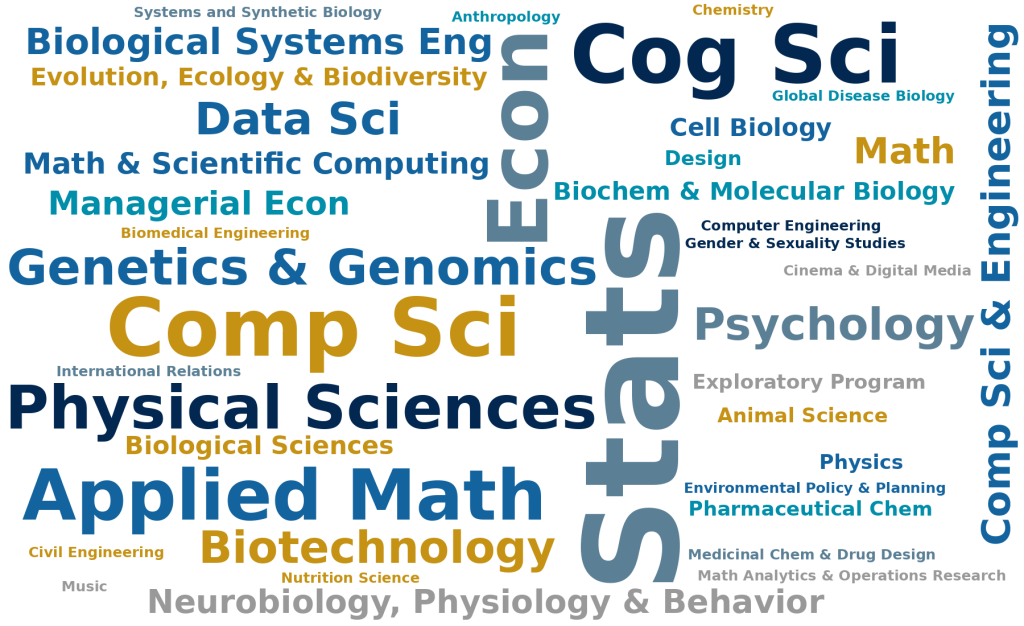
Coding forward is the philosophy of the undergraduate tutoring and leadership program I run for ECS 32A. Students who learned to code in the course have an opportunity to code it forward—returning to help the next generation of students succeed as peer educators. They are the cornerstone of Stay Late and Code nights. Since 2021, the program has attracted a talented cohort of students from many majors. A total of 112 students have served as Learning Assistants across 228 quarters of service. Nearly half (47%) return for a second term, while over a quarter (28%) serve for three or more terms. Their majors are represented in the word cloud below.

In ECS 32A: Introduction to Programming, a team of undergraduate Learning Assistants (LAs, also known as tutors) helps make this large-enrollment course more supportive, collaborative, and accessible, particularly for students whose primary field is outside computer science. Successful former ECS 32A students are invited to apply to the Learning Assistant Program and return as peer educators, receiving course credit through ECS 197T. LAs support Stay Late and Code (SLAC) sessions, where they help students develop programming, problem-solving, and debugging skills. At the same time, LAs gain valuable experience in teaching, communication, leadership, and mentorship.
The Learning Assistant model is an evidence-based approach to supporting active learning in large undergraduate STEM courses. Studies of Learning Assistant programs report benefits in learning, persistence, and students’ confidence in their ability to succeed in challenging STEM coursework. For introductory programming, this approach provides students with frequent opportunities to practice coding, ask questions, work through problems with experienced peers, and develop confidence that programming is a skill they can learn through practice. Published research across STEM disciplines shows that undergraduate peers change what a large course can do.
- Fewer students fail or withdraw (Alzen et al. 2018; Bundy et al. 2025)
- Deeper learning, not just better grades (Sellami et al. 2018)
- A stronger sense of belonging in STEM (Clements et al. 2022)
- Gains reach every group of students (Bundy et al. 2025; Sellami et al. 2018)
- One on one help that scales to a large class (Barrasso et al. 2021, Forbes et al. 2017)
- Better odds of finishing the degree (Feng et al 2025)
- Tutors grow too (Breland et al. 2023)
The majors of 102 alumni Learning Assistants:
Each major in the word cloud is weighted by the total quarters of service.
References
Alzen, J. L., Langdon, L. S., & Otero, V. K. (2018). A logistic regression investigation of the relationship between the Learning Assistant model and failure rates in introductory STEM courses. International Journal of STEM Education, 5(1), 56.
Barrasso, A. P., & Spilios, K. E. (2021). A scoping review of literature assessing the impact of the learning assistant model. International Journal of STEM Education, 8, 12.
Breland, H., Clark, C., Shaked, S., & Paquette-Smith, M. (2023). The benefits of participating in a learning assistant program on the metacognitive awareness and motivation of learning assistants. CBE—Life Sciences Education, 22(3).
Bundy, C. G., & Wong, T. E. (2025). Analyzing Learning Assistant influence on STEM student success using logistic and hierarchical regression. Contemporary Mathematics and Science Education.
Clements, T.P. et al. (2022). “It made me feel like a bigger part of the STEM community”: Incorporation of Learning Assistants enhances students’ sense of belonging in a large introductory biology course. CBE—Life Sciences Education.
Feng, L., Close, E. W., Luxford, C. J., et al. (2025). Transforming undergraduate STEM education: The Learning Assistant model and student retention and graduation rates. Research in Higher Education, 66, 4.
Forbes, J., Malan, D. J., Pon-Barry, H., Reges, S., & Sahami, M. (2017). Scaling introductory courses using undergraduate teaching assistants. Proceedings of the 2017 ACM SIGCSE Technical Symposium on Computer Science Education, 657–658.
Sellami, N., Shaked, S., Laski, F. A., Eagan, K. M., & Sanders, E. R. (2017). Implementation of a learning assistant program improves student performance on higher-order assessments. CBE—Life Sciences Education, 16(4).